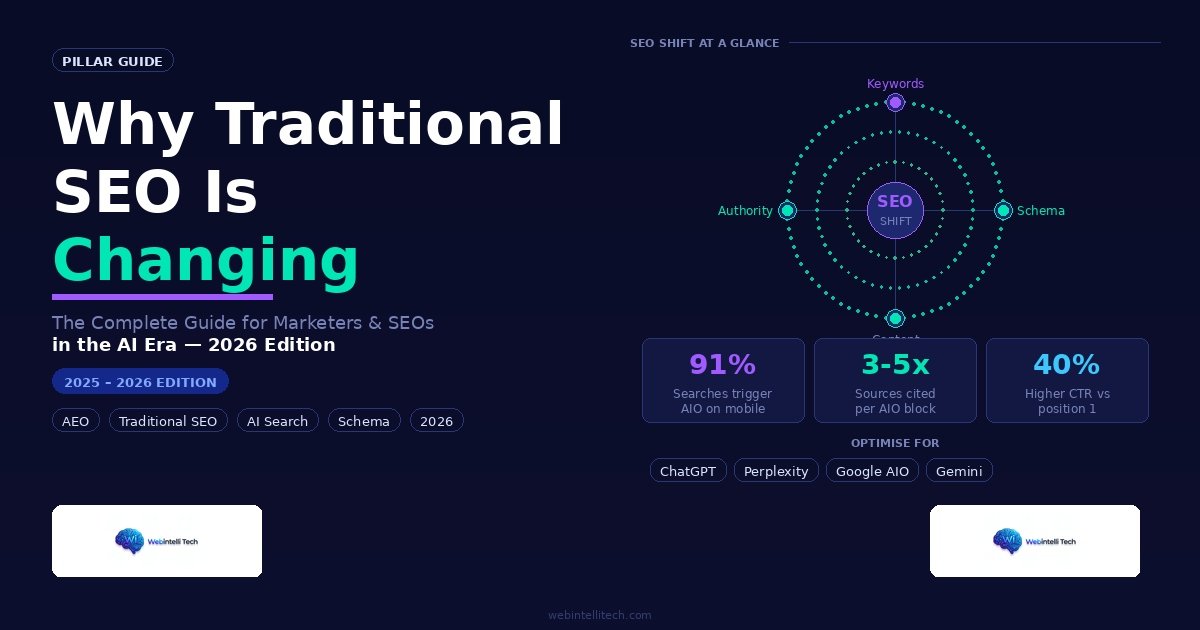
The Search Landscape Has Shifted — Permanently
For nearly two decades, the rules of digital visibility were simple: rank on Google page one, get traffic, grow your business. SEO was a game of keywords, backlinks, and technical optimisation — and if you played it well, the clicks came.
That era is over.
Not slowly fading. Not gradually declining. Over — disrupted by the same technology that disrupted every other information industry: artificial intelligence. In 2026, when someone wants to know “which is the best accounting software for a small business in India,” they are no longer necessarily opening Google. They’re asking ChatGPT. They’re querying Perplexity. They’re letting Google’s own AI Overview answer them before a single organic result is clicked.
The result? A fundamental rewiring of how search visibility works, who gets found, and what optimisation even means. This blog breaks down exactly what’s changing, why it matters, and what you need to do about it — right now.
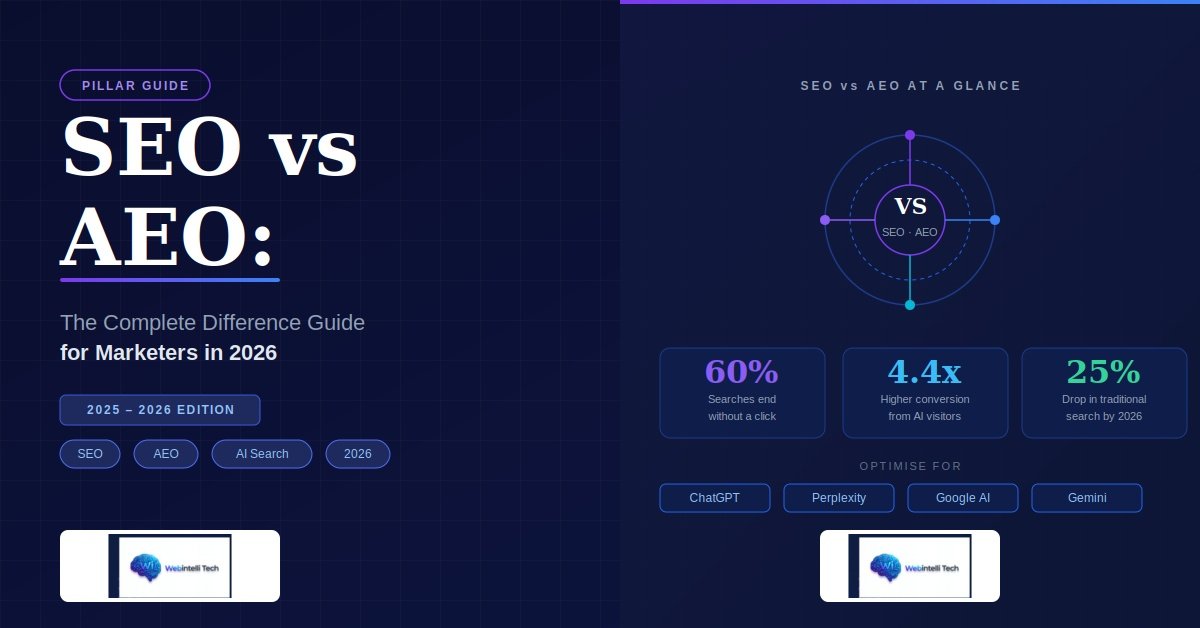
| 68%
Searches end without a click in 2026 |
800M+
ChatGPT weekly active users in 2026 |
40%
Drop in organic CTR since 2022 |
3×
AI answer query growth in 12 months |
How Traditional SEO Is Changing: A Timeline From 2005 to 2026
To understand where we’re going, you have to understand where we’ve been. SEO didn’t break overnight — it evolved through several distinct eras, each one triggered by a major shift in how search engines evaluated quality.
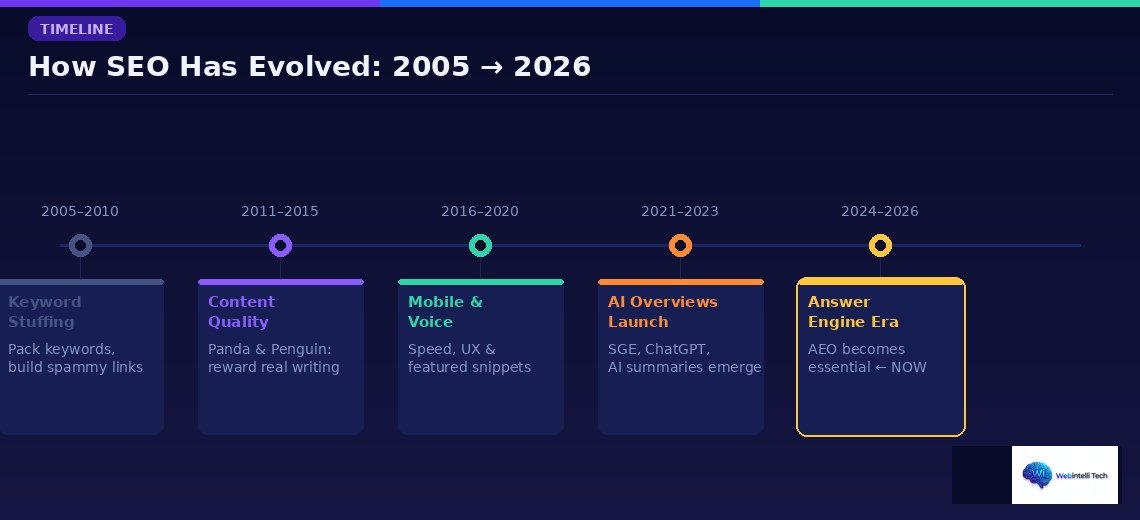
Figure 1: SEO has gone through five distinct eras. We are now in the Answer Engine Era.
The Keyword Stuffing Era (2005–2010)
In the early internet, SEO was almost embarrassingly mechanical. Rank by density. Repeat your target keyword as many times as possible. Build spammy links. Google’s algorithm wasn’t sophisticated enough to distinguish quality content from keyword-crammed noise — so every page looked the same and ranking was a numbers game.
The Content Quality Era (2011–2015)
Google Panda (2011) and Penguin (2012) changed everything. Thin content and manipulative link schemes were penalised. Marketers had to actually write well. Long-form, well-researched content started to win. “Content is king” became the mantra — quality finally started to be rewarded.
The Mobile and Voice Era (2016–2020)
Google’s mobile-first indexing, Core Web Vitals, and the rise of voice search pushed SEOs toward page speed, UX, and conversational keywords. Featured snippets emerged — a preview of things to come — where Google began displaying the answer rather than just linking to it.
The AI Overviews Era (2021–2023)
SGE (Search Generative Experience), ChatGPT’s public launch in late 2022, and Google’s AI Overviews fundamentally changed user behaviour. For the first time, a search engine could synthesise an answer from multiple sources instead of just ranking links. The search engine wasn’t just a directory anymore — it was an answering machine.
The Answer Engine Era (2024–2026) — Where We Are Now
Today, the question isn’t just “how do I rank on Google?” The question is: “how do I become the source that AI models cite when they answer my customers’ questions?” This is AEO — and it requires a completely different playbook.
The Zero-Click Crisis: What Is Happening to Your Traffic
The most concrete and painful symptom of the AI era for SEOs is the “zero-click search” — a query that is fully satisfied by the search engine itself, without the user ever clicking through to a website.
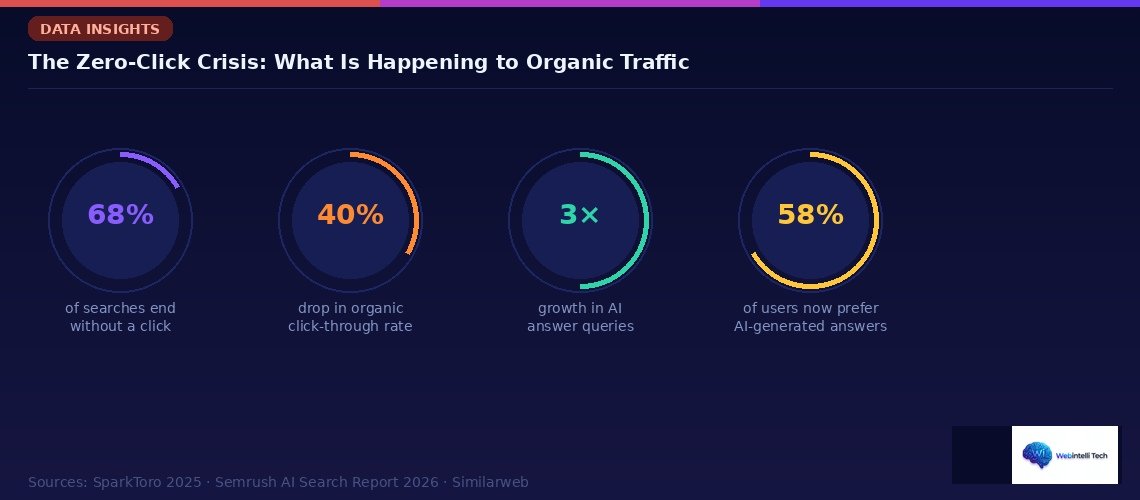
Figure 2: The zero-click crisis in numbers — how AI summaries are reducing click-through rates across industries.
This isn’t new — featured snippets were already creating zero-click scenarios — but AI Overviews and tools like ChatGPT have turbocharged the phenomenon. When ChatGPT answers “what is the repo rate in India today?” with a complete, sourced, well-formatted answer, the user has no reason to visit any website. They got what they came for.
| ⚠️ THE HARD TRUTH
If your SEO strategy is still built entirely around driving traffic through blue-link rankings, you are measuring a metric that is in structural decline. Organic CTR across most industries has fallen 30–40% since 2022. The clicks that do happen are increasingly going to high-authority, well-structured pages that AI models have already validated as trusted sources. |
The irony is this: zero-click does not mean zero-opportunity. A brand that gets cited by ChatGPT in its answer — even without a click — gains enormous brand exposure. Users see the brand name, associate it with expertise, and are far more likely to search for it directly later. This is the new currency of search: AI citation visibility.
5- Fundamental Ways SEO Is Changing in the AI Era
Here are the five most important structural shifts happening in search right now — and what each one means for how you create content and optimise your website.
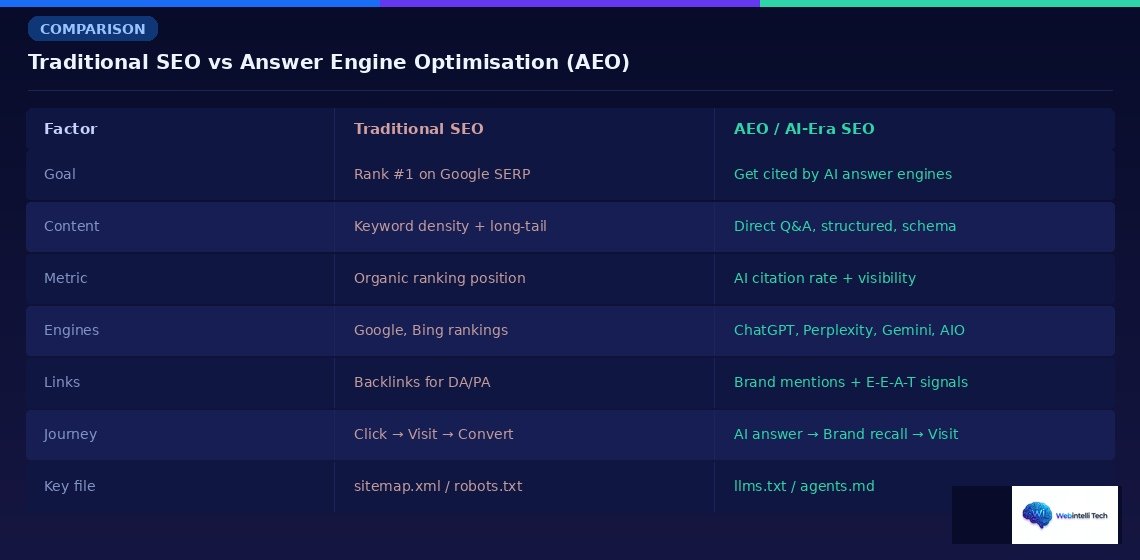
Figure 3: The five fundamental disruptions reshaping SEO in 2026.
Shift 01 — Keywords → Conversational Intent
AI models do not match keyword strings — they understand the meaning and intent behind a question. Optimising for “best CRM software India 2026” matters less than structuring your content to directly answer: “What CRM should a small business in India use and why?” The shift is from keyword matching to semantic understanding.
Shift 02 — Rankings → AI Citations
Position #1 on a SERP used to be the only goal. Now, being cited inside an AI-generated answer is worth more — it appears above all organic results, reaches users who never scroll to links, and carries the implied endorsement of the AI itself. One AI citation can reach more people than a page-one ranking.
Shift 03 — Backlinks → E-E-A-T and Brand Authority
Raw link counts are less decisive. AI models weigh brand mentions across the web, author credentials, citation patterns in authoritative sources, and structured signals like schema markup. E-E-A-T (Experience, Expertise, Authoritativeness, Trust) is now the primary quality framework for both Google and AI models.
Shift 04 — Click Traffic → Brand Visibility
Your website may be cited in hundreds of ChatGPT responses without a single click recorded in your analytics. This means traditional traffic metrics dramatically undercount your actual AI-era reach. New KPIs are needed: AI mention tracking, brand search volume growth, and citation rate monitoring across AI tools.
Shift 05 — Content Volume → Answer Quality
The era of “publish 10 thin posts a week” is definitely over. One perfectly structured, deeply authoritative, schema-marked answer page outperforms twenty shallow posts in every AI ranking signal. Quality and specificity have never mattered more than they do right now.
Why Ranking #1 Is No Longer the Goal
This is the hardest mental shift for traditional SEOs — and the most important one. For two decades, the entire discipline was oriented around a single metric: ranking position. You measured success in positions. You reported to clients in positions. Your agency fees were tied to positions.
| “A brand cited in a ChatGPT answer that 500,000 people read today has more influence than a #1 ranking on a keyword that gets 2,000 monthly searches.”
— Core principle of modern Answer Engine Optimisation |
Here is the new reality: Google’s AI Overview appears above all organic rankings. It synthesises and answers. Below that are paid ads. Below that are featured snippets. Only then do traditional blue links appear — and most users have already found their answer before reaching them.
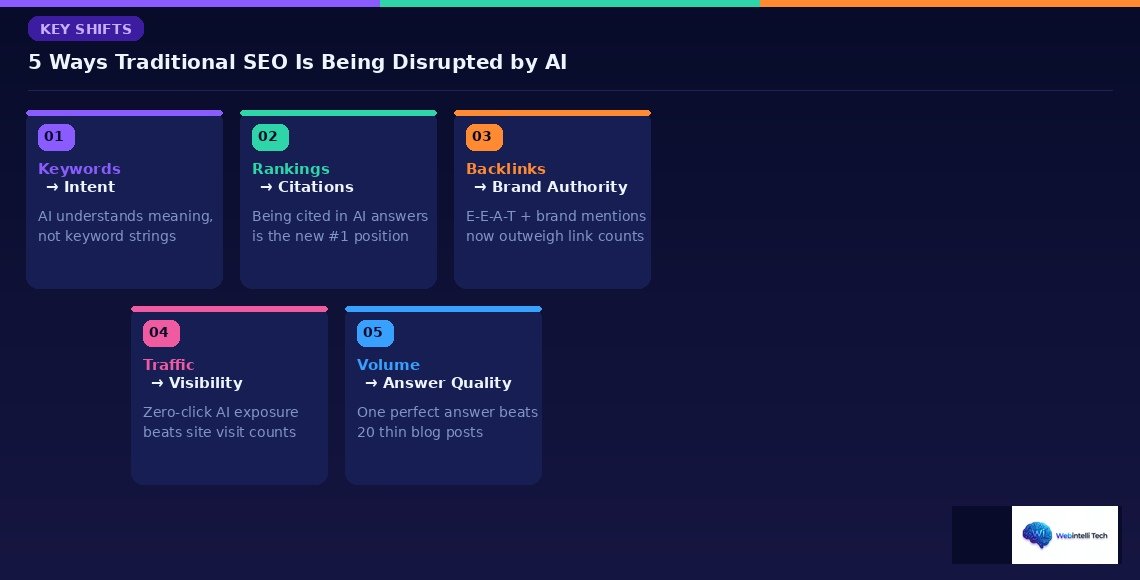
Figure 4: Traditional SEO vs AEO — a side-by-side comparison of goals, metrics, and optimisation strategies.
| Factor | Traditional SEO | AEO / AI-Era SEO |
| Goal | Rank #1 on Google SERP | Get cited by AI answer engines |
| Content | Keyword density + long-tail | Direct Q&A, structured, schema |
| Metric | Organic ranking position | AI citation rate + visibility |
| Engines | Google, Bing (rankings) | ChatGPT, Perplexity, Gemini, AIO |
| Link signals | Backlinks for DA/PA boost | Brand mentions + E-E-A-T signals |
| User journey | Click → Visit → Convert | AI answer → Brand recall → Visit |
| Key file | sitemap.xml / robots.txt | llms.txt / agents.md |
| ✅ THE NEW SUCCESS METRIC
Start tracking your “AI citation rate” — how often your brand or content is referenced when AI tools answer questions in your niche. Tools like Profound, Otterly.ai, and manual ChatGPT spot-checks can help you measure this emerging KPI alongside traditional Google Search Console data. |
| 🎓 WEBINTELLITECH AEO COURSE
Get the complete AEO playbook — built for 2026 Learn exactly how to optimise for ChatGPT, Perplexity, Google AIO, and Gemini with plug-and-play templates, schema code snippets, and a 30-day action plan you can start today. |
How to Adapt: Your AEO Action Plan
Understanding the shift is step one. Acting on it is what separates the marketers who will thrive in the AI era from those who will struggle to understand why their traffic keeps declining despite doing “good SEO.”
Here is a prioritised action plan for transitioning from traditional SEO to AEO in 2026:
- Audit your content for direct-answer structure
Go through your top 10 ranking pages. Does each H2 have a concise 40–60 word direct-answer paragraph immediately below it? If not, rewrite them. This single change has the biggest measurable impact on AI citation rate and is something you can do this week.
- Implement the FAQ schema on every informational page
Use Rank Math or Yoast SEO to add FAQ schema blocks to all blog posts and service pages. This structured data is machine-readable and directly feeds AI models’ understanding of your content’s topic and intent format.
- Submit your sitemap to Bing Webmaster Tools
ChatGPT’s live browsing is powered by Bing. If Bing does not have your site indexed and verified, ChatGPT cannot cite you in real-time queries. This is free, takes 10 minutes, and has an outsized impact on AI citation visibility.
- Build strong E-E-A-T signals across your website
Add detailed author bios with credentials and links to professional profiles. Link out to authoritative external sources in every post. Add a clear “About” page. Get your brand mentioned in industry publications. These trust signals matter enormously for AI models evaluating source quality.
- Create an llms.txt file for your website
A new AI-readiness standard, llms.txt, is a plain-text file you add to your root domain that tells AI crawlers what your site is about, what content is available, and how it should be used. Think of it as robots.txt for AI models. Webintelli Tech builds these as a client service.
- Rewrite H2 headings as natural questions
Instead of “Benefits of Cloud Accounting Software,” write “What are the benefits of cloud accounting software for small businesses?” This directly aligns with how users phrase queries to AI tools and makes it far easier for models to match your section to a specific query intent.
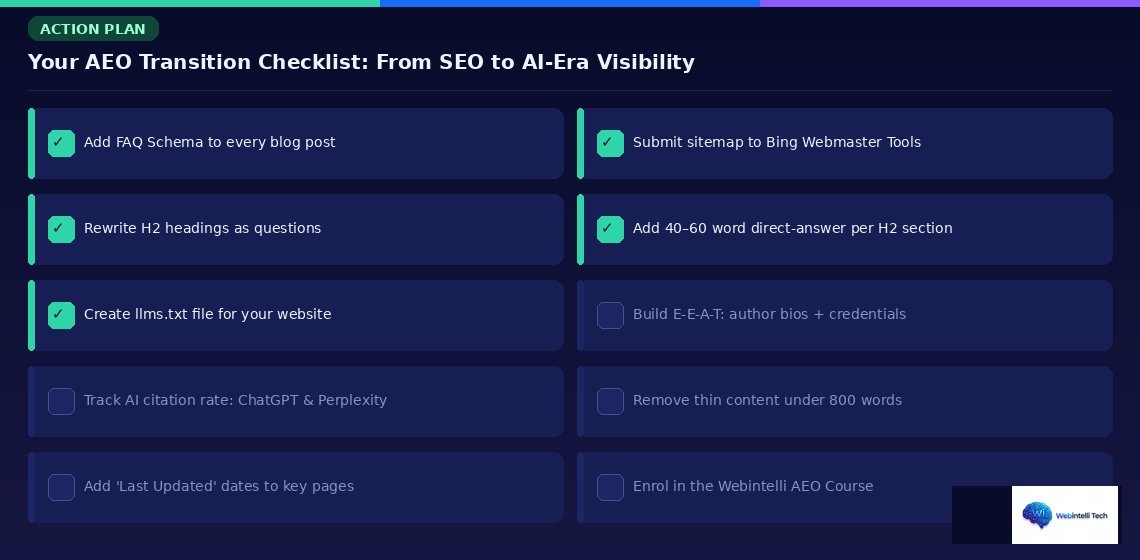
Figure 5: Your complete AEO transition checklist — work through this for every key page on your website.
| 💡 DO NOT ABANDON SEO — EVOLVE IT
Traditional SEO signals (backlinks, technical health, page speed, Core Web Vitals) still matter enormously. AI models use Google and Bing rankings as a proxy for trust. The goal is not to replace your SEO strategy — it is to layer AEO on top of it so you are visible in both traditional search and AI-powered answers. |
Key Takeaways
- The shift from keyword rankings to AI citations is the most significant change in search since Google’s Panda update — and it is happening right now, not in the future.
- Zero-click searches now represent 68% of all queries. Traffic from search will keep declining if you rely solely on traditional SEO blue-link rankings.
- The five core shifts to internalise: keywords → intent, rankings → citations, backlinks → E-E-A-T, traffic → visibility, content volume → answer quality.
- Being cited in a ChatGPT or Perplexity answer is the new #1 ranking — and it requires a completely different optimisation strategy than traditional SEO.
- Your immediate action items: direct-answer paragraphs, FAQ schema, Bing sitemap submission, E-E-A-T signals, llms.txt creation, and question-format H2 headings.
- Traditional SEO is not dead — but it must evolve into an AEO strategy to remain effective in 2026 and every year beyond.
The brands that adapt now will establish citation authority while competitors are still arguing about whether AI search is “real.” The window to become an early AI-cited authority in your niche is open — but it will not stay open forever.
| 🎓 WEBINTELLITECH AEO COURSE
AEO Course: Rank in ChatGPT, Perplexity & Google AIO in 2026 Full implementation roadmap — schema templates, content frameworks, llms.txt guide, Bing optimisation checklist, and a 30-day AEO plan you can begin today. Instant download on Gumroad. |
Tags: Traditional SEO · AEO · AI Search 2026 · SEO Is Changing · Zero-Click Search · ChatGPT SEO · E-E-A-T · Answer Engine Optimisation
WebIntelliTech Team
SEO & AEO Strategists
Want this content working for your business?
Get a free content audit and see which pages can rank higher and get cited by AI.